What Is a Good Shopify Conversion Rate? (2026 Benchmarks)
Average Shopify conversion rates sit between 1.4% and 3.3%. Here's what good looks like for UK DTC brands — and what's holding most stores back.
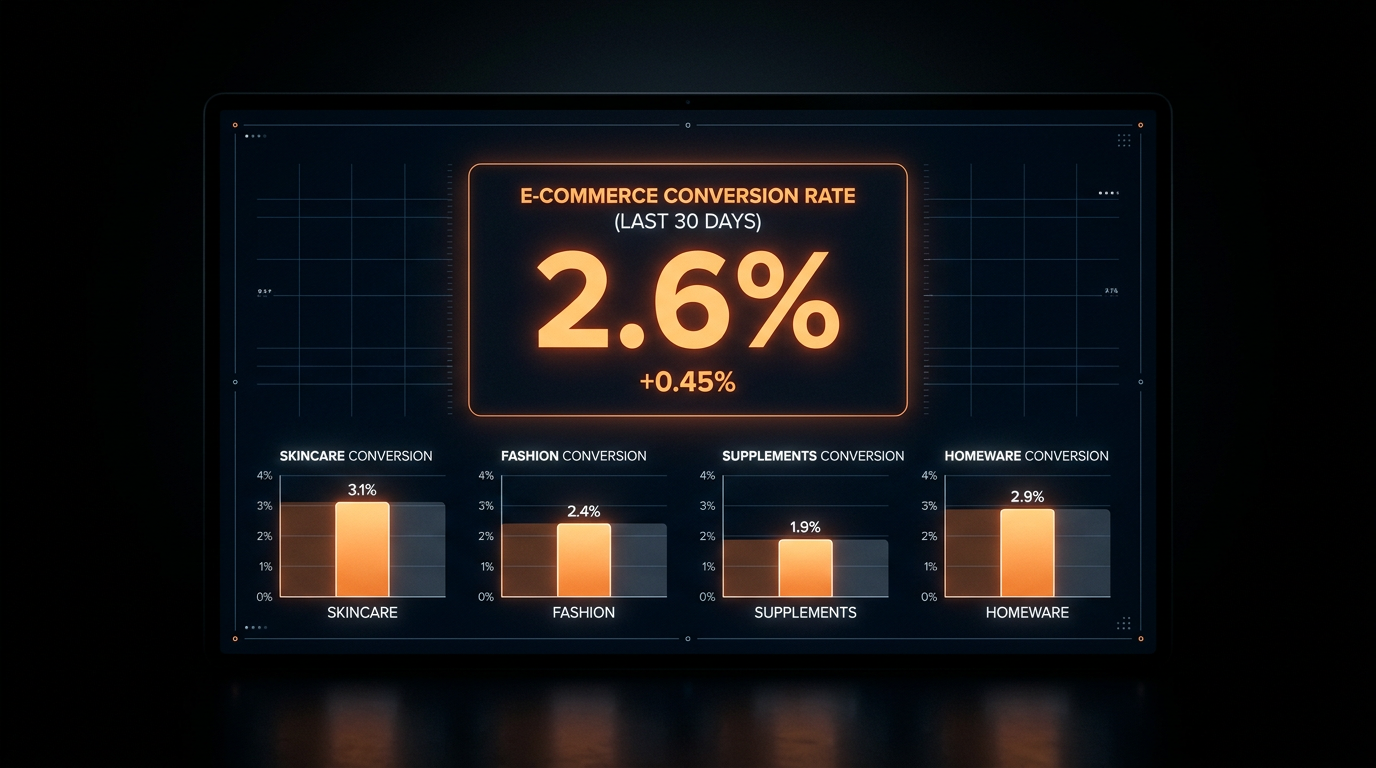
A good Shopify conversion rate for a UK DTC brand is 2.5% to 3.5%. The industry average sits around 1.4% to 1.8%. If you are below 2%, you have a significant revenue opportunity sitting untapped in your existing traffic. Most brands address this by spending more on ads — which is the wrong order of operations.
Shopify Conversion Rate Benchmarks by Sector (2026)
Not all Shopify stores should be measured against the same benchmark. Conversion rates vary significantly by vertical, price point, and traffic source. Here is what we see across UK DTC brands in 2026:
Skincare and Beauty
2.8% – 4.2%Strong repeat purchase intent and ingredient-driven decisions. High trust signals matter more than price. Email capture converts well.
Apparel and Fashion
1.5% – 2.8%Returns friction and sizing uncertainty suppress conversions. Mobile UX is critical — over 70% of fashion traffic is mobile.
Supplements and Health
2.2% – 3.8%Subscription models push CVR up. Cold traffic converts poorly without proof — testimonials and clinical backing are essential.
Homeware and Furniture
1.0% – 2.0%Higher AOV means longer consideration cycles. Wishlist and save-for-later features recover significant intent that would otherwise be lost.
Food and Drink
3.0% – 5.0%Impulse buying behaviour and frequent gifting occasions. Bundles and subscriptions consistently lift AOV and CVR simultaneously.
Why Your Number Matters More Than the Average
Benchmarks are a starting point, not a target. What actually matters is your store's conversion rate trend over time. A brand converting at 1.8% today that was at 0.9% six months ago is in a fundamentally different position than one stuck at 1.8% for two years.
The more useful comparison: your conversion rate by traffic source. Most Shopify analytics views blend paid, organic, and email traffic together — which masks the real problems. Paid social traffic converting at 0.6% while email converts at 8% is not a CRO problem, it is a landing page targeting problem.
What Separates a 1.5% Store From a 3.5% Store
After auditing dozens of UK Shopify stores, the gap between average and strong converters consistently comes down to four things:
1. Mobile product page UX
High-converting stores make the add-to-cart action frictionless on a 375px screen. Size selectors, image galleries, and trust signals all need to work with one thumb. Most do not.
2. Checkout abandonment recovery
The average Shopify checkout abandonment rate is 72%. Stores with recovered checkout flows — through trust signals, progress bars, and exit-intent logic — consistently outperform those without by 20-30%.
3. Social proof placement
Reviews buried in a tab at the bottom of the page do almost nothing. High-converting PDPs surface star ratings near the price, include photo reviews near the fold, and use scarcity signals close to the CTA.
4. Page speed under 2.5 seconds
Every additional second of mobile load time cuts conversion rate by approximately 4.5%. A store loading in 4 seconds is leaving 7-9% of conversions on the table relative to a 2-second store — before any CRO work begins.
How to Calculate Your True Conversion Rate
Shopify's native analytics calculates conversion rate as: sessions resulting in a purchase divided by total sessions. This includes bot traffic, internal team visits, and admin sessions — which inflates your denominator and deflates your reported CVR.
A cleaner method: filter your GA4 data to UK traffic only, exclude sessions under five seconds (likely bots), and segment by device type. Your real mobile conversion rate is almost always 30-50% lower than desktop — which tells you exactly where to focus first.
When to Invest in CRO
CRO requires traffic volume to generate statistically significant test results. If your store receives fewer than 20,000 monthly visitors, systematic A/B testing will take too long to reach significance. At that stage, qualitative improvements — fixing obvious friction points, improving trust signals, optimising checkout — will move the needle faster than split testing.
Once you cross 40,000 monthly visitors, you have enough data volume to run meaningful tests in 2-3 weeks. That is when a structured CRO programme starts to compound returns.
The Revenue Maths
A brand generating 50,000 monthly visits at an AOV of £65 and a 1.6% conversion rate makes approximately £52,000/month in revenue. Lifting conversion to 2.4% — a 50% relative improvement — generates £78,000/month. That is £26,000 per month in additional revenue from the same traffic budget. No new ads. No new products.
This is why conversion rate is the highest-leverage metric in DTC. Speed is often the lowest-hanging fruit: a Shopify PageSpeed optimisation that reduces load time from 4s to 2s can recover 8-12% of conversions before a single test is run.
Frequently Asked Questions
What is a good Shopify conversion rate in the UK?
A good Shopify conversion rate for a UK DTC brand is 2.5% to 3.5%. The UK average is around 1.4% to 1.8%. Anything above 3% puts you in the top 20% of Shopify stores. Rates vary by vertical: beauty brands typically see 2.8–4.2%, while apparel sits at 1.5–2.8%.
Is a 1% Shopify conversion rate bad?
Yes — 1% is below the UK average of 1.4% to 1.8% and suggests significant friction in your store. The most common causes are slow mobile load times, unclear product pages, trust signal gaps, and checkout friction. Each of these can be diagnosed and fixed without increasing ad spend.
How does Shopify calculate conversion rate?
Shopify calculates conversion rate as the number of sessions that resulted in a purchase divided by total sessions. It includes all sessions — including bots and internal traffic — which can distort the figure. For accurate data, use GA4 with bot traffic filtered out and segment by device type.
What conversion rate do I need before hiring a CRO agency?
There is no minimum conversion rate requirement — but you do need sufficient traffic. Most CRO agencies recommend at least 20,000–40,000 monthly visitors before systematic A/B testing generates meaningful results in a reasonable timeframe. Below that, qualitative CRO (fixing friction points) is more efficient.
How quickly can I improve my Shopify conversion rate?
Quick wins — fixing mobile UX, improving page speed, adding trust signals — can move the needle within days. Systematic A/B testing typically shows statistically significant winners within 2–4 weeks per test. A full CRO programme targeting 50%+ CVR lift typically runs over 90–180 days.
Find Out Where Your Store Is Losing Revenue
Book a free audit. We will review your conversion funnel, identify the highest-impact friction points, and give you a clear picture of what a realistic CVR improvement looks like for your store.
Get Free Audit