The True Cost of a Slow Shopify Store
A Shopify store loading in 4 seconds loses 12–18% of its potential revenue compared to the same store at 2 seconds. Here is how to calculate exactly what slow is costing you.
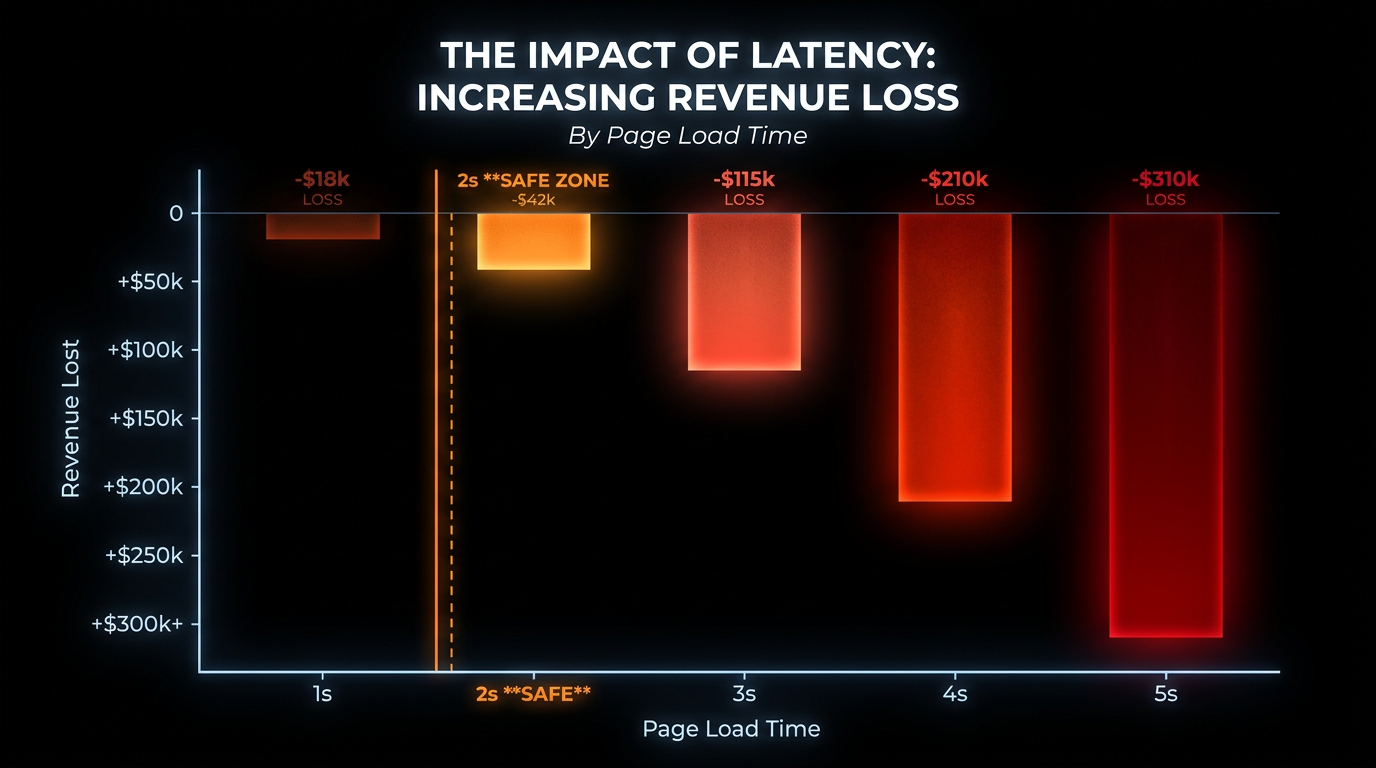
A Shopify store loading in 4 seconds on mobile is losing approximately 4.5% of its potential conversions for every additional second beyond 1 second. That is a calculable number — not a rough estimate. For a brand doing £80K/month, the difference between a 4-second and a 2-second load time is roughly £14,000 in monthly revenue. This is the exact calculation to figure out what slow is costing your store.
The Revenue Loss Formula
Google's mobile page speed research quantifies the relationship between load time and conversion rate. The relationship is not linear — the impact is largest in the 0-3 second window, where most mobile users decide whether to stay or leave.
Revenue Loss Calculator
Source: Google/SOASTA research. Figures represent relative CVR reduction versus a 1-second baseline.
A Worked Example
Take a Shopify brand with these characteristics:
- →Monthly revenue: £80,000
- →Mobile traffic share: 68%
- →Current mobile load time: 4.2 seconds
- →After optimisation: 1.9 seconds
Mobile traffic represents 68% of £80,000 = £54,400/month. At a 4.2-second load time, this traffic is converting at approximately 65% of its potential rate (35% CVR suppression from the table above). The potential mobile revenue at a 1.9-second load time is £54,400 / 0.65 = £83,692. The difference: £29,292/month. Against a one-time PageSpeed optimisation cost of £3,000, the payback period is under two weeks.
Where the Speed Loss Is Compounding
Speed loss does not just suppress direct conversion rate. It creates three compounding negative effects that are harder to measure but equally real:
SEO ranking suppression
Google uses Core Web Vitals as a ranking signal. A slow store ranks lower for the same keywords than a faster competitor. The revenue impact of lower search rankings is harder to calculate but compounds over time — slower stores lose ground to faster competitors in organic search.
Paid ad cost inflation
Google Ads Quality Score includes landing page experience, which factors in load speed. A slow landing page inflates cost-per-click and reduces ad delivery. Meta Ads similarly penalises slow post-click experiences through reduced delivery and higher CPMs.
Repeat purchase suppression
Customers who experienced a slow checkout are less likely to return. Session recording data consistently shows that slow load times increase negative sentiment throughout the purchase journey — not just at the abandonment moment.
How to Find Your Store's Mobile Load Time
Go to Google PageSpeed Insights (search for it) and enter your most-visited product page URL. The "Mobile" tab shows your LCP (Largest Contentful Paint) — which is the most relevant metric for the speed-to-conversion relationship.
LCP under 2.5 seconds: good. 2.5-4 seconds: needs improvement, measurable revenue impact. Over 4 seconds: significant revenue loss, priority fix. The "Field Data" section (real user data from Chrome) is more meaningful than the "Lab Data" section (simulated test).
What Shopify Speed Optimisation Actually Costs
The most common response to a speed problem is installing a speed optimisation app from the Shopify App Store. These apps rarely solve the underlying causes — they add another layer of code on top of existing problems, which often makes things worse. The root causes of Shopify speed problems require code-level changes: theme optimisation, image resizing, script deferral, app audit.
A professional Shopify PageSpeed optimisation that addresses all root causes and guarantees minimum scores costs £3,000 as a one-time investment. For a store losing £15,000-30,000/month to slow load times, the payback period is typically 1-3 weeks.
Frequently Asked Questions
How much revenue does a slow Shopify store lose?
The amount depends on current load time and traffic volume. A store loading in 4 seconds loses approximately 35% of potential mobile conversions versus the same store at 1-2 seconds. For a brand doing £80K/month with 68% mobile traffic, this translates to approximately £14,000–£20,000/month in suppressed revenue — before accounting for SEO ranking impact and paid ad efficiency losses.
Does Shopify page speed affect Google Ads performance?
Yes. Google Ads Quality Score includes landing page experience, which considers load speed. A slow landing page results in lower Quality Score, which means higher cost-per-click and reduced ad delivery for the same budget. Improving page speed typically reduces CPC by 8–15% for brands spending £5K+/month on Google Ads.
What is a good Shopify LCP score?
LCP (Largest Contentful Paint) under 2.5 seconds is considered good by Google's Core Web Vitals standards. 2.5–4 seconds needs improvement. Over 4 seconds is poor. For Shopify stores specifically, LCP under 2 seconds on mobile field data (real user data) is the target for competitive conversion rates.
Do Shopify speed optimisation apps actually work?
Rarely for the root causes. Most speed apps work by deferring scripts — which can break functionality and does not address unoptimised images, bloated theme code, or excessive app loading. Many clients come to us after trying 2–3 speed apps that failed to move their score. Root-cause optimisation requires code-level changes to the theme, not an additional app layer.
Find Out Exactly What Slow is Costing Your Store
We audit your Shopify store's performance for free — mobile load time, Core Web Vitals, and the specific causes of speed loss — and calculate the revenue impact in pounds, not percentages.
Get Free Speed Audit